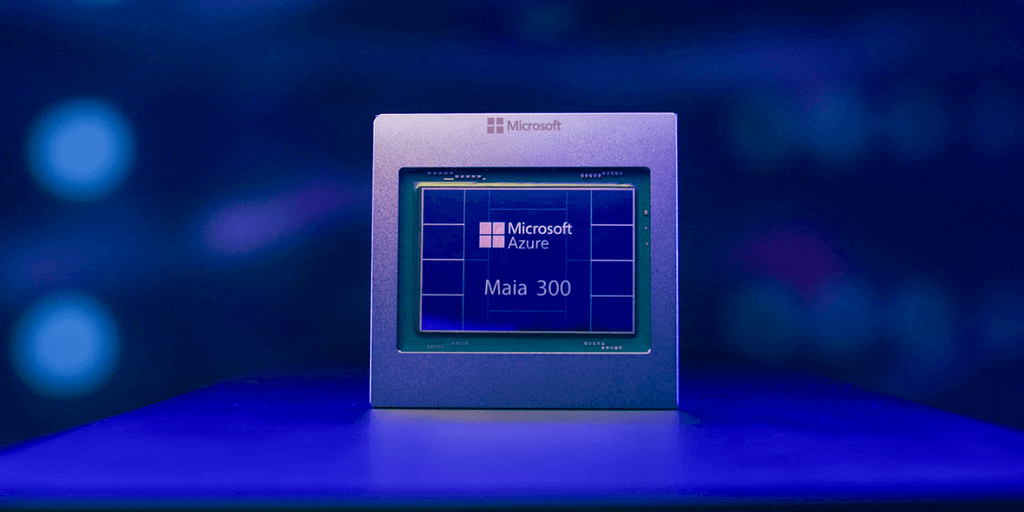
Custom artificial intelligence processors are becoming increasingly important as technology companies seek better performance and lower operating costs.
Microsoft’s reported Maia 300 AI accelerator announcement on October 12 highlighted a major shift in the technology industry: the competition to develop artificial intelligence increasingly depends on the hardware powering digital services.
As generative AI tools become more common in workplaces and consumer applications, companies must process growing volumes of information while maintaining acceptable performance, reliability, and cost. Specialized processors offer one way to address those demands by tailoring computing resources to the mathematical operations used by AI systems.
The reported Maia 300 development reflects Microsoft’s broader interest in custom silicon and large-scale infrastructure. The company’s cloud and software businesses provide potential applications for processors designed to support AI workloads.
Why AI Hardware Is Becoming More Important
Artificial intelligence models require substantial computing resources during training and when generating responses for users. Training involves processing large datasets to develop a model’s capabilities, while everyday use requires systems to respond to individual requests quickly and consistently.
Specialized AI accelerators are designed to perform these operations efficiently. Their architectures can be optimized for particular workloads, allowing developers to make trade-offs among processing speed, memory access, energy consumption, and cost.
The practical effect can be significant for companies operating AI services at scale. When millions of requests are processed, improvements in the resources needed for each task can influence overall operating expenses.
However, processor performance depends on more than the chip itself. Software optimization, memory capacity, networking, cooling, and the design of the overall computing system also affect how efficiently workloads run.
What Custom Silicon Means for Microsoft
Developing custom processors gives a technology company more influence over its computing infrastructure. Instead of relying exclusively on commercially available hardware, a company can design chips around the requirements of its own services.
For Microsoft, that strategy could support workloads across its cloud platform and software ecosystem. AI features are increasingly integrated into applications used for communication, document creation, information retrieval, and software development.
The potential advantage is greater control over the relationship between hardware and software. A processor designed around specific workloads may offer opportunities to improve efficiency or allocate computing resources more precisely.
Custom chip development nevertheless requires substantial investment and specialized expertise. Designs must be manufactured, tested, integrated with supporting components, and supported by software tools before they can operate reliably in production environments.
The announcement of a processor therefore represents one stage in a longer development process rather than proof of immediate improvements for every customer.
The Workplace Implications
AI computing infrastructure affects the tools available to employees and businesses. Software that summarizes information, assists with coding, organizes documents, or answers questions relies on processing capacity behind the scenes.
If providers can deliver these functions more efficiently, they may gain greater flexibility in how services are priced and deployed. Businesses could benefit from improved availability or access to more capable features, depending on how those infrastructure gains are passed through to customers.
Yet organizations should not evaluate AI tools on speed alone. Accuracy, security, privacy, compatibility, and the need for human review remain important considerations.
An AI assistant that responds quickly but produces unreliable information may create additional work rather than improving productivity. Businesses also need to understand how sensitive information is handled and whether an application meets their internal requirements.
Hardware advances can expand what software providers can offer, but they do not remove the responsibility to assess each tool’s suitability for a specific task.
Energy and Infrastructure Constraints
AI data centers require more than processors. They depend on electricity, cooling, networking, physical space, and reliable connections to supporting infrastructure.
As companies increase their computing capacity, energy availability can become a limiting factor. More efficient hardware can help reduce the resources required for individual operations, but total consumption also depends on the amount of AI activity taking place.
A successful reduction in per-task computing costs can encourage broader adoption, potentially increasing total demand. That dynamic makes efficiency an important but incomplete measure of the technology’s overall resource requirements.
Companies developing large AI systems must therefore consider infrastructure planning alongside chip design. The availability of electricity and the time required to build or upgrade data centers can influence how quickly new hardware is deployed.
Competition and Consumer Impact
Microsoft is operating in a competitive market where technology companies are investing in both advanced AI models and the infrastructure required to run them. Custom processors are one part of a broader effort to control performance, cost, and the pace of innovation.
For consumers, these developments may eventually influence the speed and availability of digital assistants and other AI-enabled services. For businesses, the impact will depend on whether improvements translate into more useful tools, dependable service, and manageable costs.
Independent performance evaluations and real-world deployments will be important in determining the value of new processors. Claims about efficiency or capacity need to be assessed in the context of specific workloads and comparable systems.
What Comes Next
The reported Maia 300 announcement illustrates how AI development is increasingly linked to the economics of computing infrastructure. Building capable models is only one challenge; delivering them to large numbers of users requires hardware and systems that can operate efficiently.
Microsoft’s longer-term success will depend on how effectively its processor development supports its services and customer requirements. Manufacturing, integration, software support, and deployment scale will all influence the results.
For workers and technology users, the broader lesson is that advances in AI are not driven by software alone. Behind every widely used digital service is an infrastructure system that determines how quickly, reliably, and affordably it can operate.

Men’s Insider Contributor
Nicole Warren
Covers entrepreneurship, career growth, and business trends with accessible insights for a broad audience.
This article features partner, contributor, or branded content from a third party. Members of the Men’s Insider editorial staff were not involved in the creation of this content. All views and opinions are those of the contributor alone.