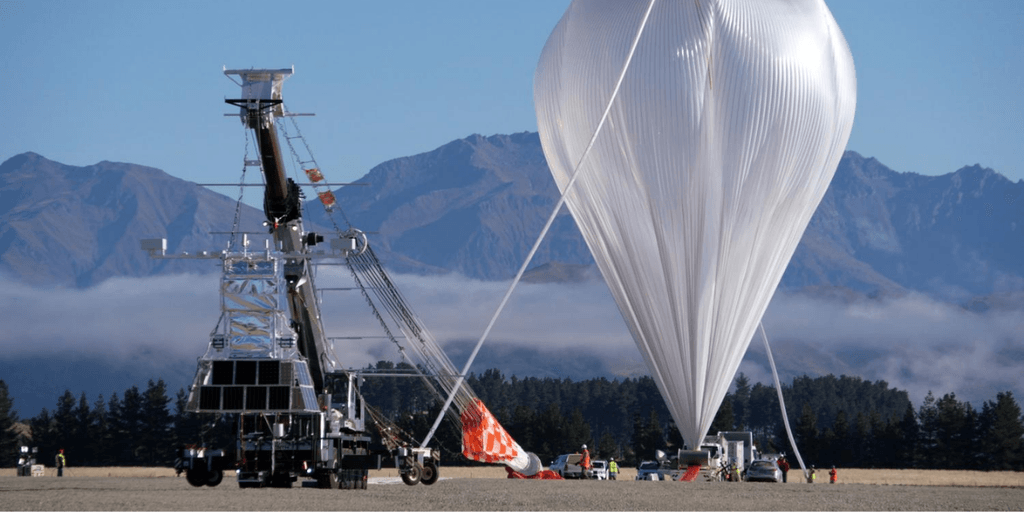
NASA launched a high-altitude technology demonstration Monday designed to test a camera system that could eventually help spacecraft identify safer landing areas on the Moon and Mars.
The CLIC 2 mission lifted off from NASA's balloon facility in Fort Sumner, New Mexico, reaching approximately 126,000 feet before completing a flight lasting three hours and 41 minutes.
At the center of the mission was a small imaging system capable of processing photographs in real time.
The technology could become useful for future planetary exploration because spacecraft often have only a short period in which to evaluate terrain before landing.
A traditional approach can rely heavily on preloaded maps and instructions sent from Earth. However, planetary surfaces can contain unexpected hazards, and communication delays can make it difficult for controllers to respond quickly.
A system that processes images onboard could provide spacecraft with information while they are still approaching the surface.
The CLIC technology is being evaluated as a possible tool for identifying suitable landing locations for future lunar or Martian rovers.
The balloon flight does not mean that the camera system is ready for a planetary mission. Instead, it represents another stage in the engineering process.
High-altitude balloons provide NASA with a relatively accessible platform for testing equipment in conditions that resemble certain aspects of the near-space environment.
At roughly 126,000 feet, the balloon operated far above ordinary commercial aircraft. The thinner atmosphere and low temperatures provide engineers with a useful environment for testing aerospace hardware.
The system's ability to process images in real time is particularly important.
Spacecraft increasingly rely on autonomous technology because missions can operate at distances where immediate human control is impossible. Mars, for example, is hundreds of millions of miles away from Earth, and signals can take significant time to travel between the two planets.
A rover or lander therefore cannot always wait for a human operator to analyze every image before making a time-sensitive decision.
Onboard computing can help address that limitation.
The system can potentially examine images, identify relevant terrain characteristics and provide information to the spacecraft's navigation or landing systems.
The challenge is making those systems reliable enough to operate without human intervention.
Planetary environments are unforgiving. A spacecraft approaching the surface must manage speed, altitude and orientation while avoiding terrain hazards.
Even small errors can result in mission failure.
Testing camera and processing technology before it reaches space is therefore an important part of reducing risk.
The CLIC 2 mission is the second flight for the Compact Large-sensor Imaging Camera project. The additional flight provides researchers with another opportunity to evaluate performance and identify areas that require improvement.
The use of a balloon also makes repeated testing more practical than relying exclusively on rocket launches.
A rocket mission involves substantial expense and preparation, while balloon flights can allow engineers to test experimental systems more frequently.
That makes high-altitude balloons an important bridge between laboratory development and spaceflight.
The mission also reflects the increasing role of artificial intelligence and automated data processing in space exploration. Although the CLIC system is primarily an imaging technology demonstration, its purpose is closely connected to the broader goal of enabling spacecraft to interpret their surroundings without constant instructions from Earth.
That capability could become increasingly valuable as missions travel farther from Earth.
For astronauts, similar technologies could eventually help identify safe routes or landing locations during human exploration.
For robotic missions, automated terrain assessment could make spacecraft more flexible when operating in unfamiliar environments.
The technology is still in development, however, and additional testing would be required before it could support an operational lunar or Martian mission.
NASA's August 24 balloon launch nevertheless marked a concrete step in that process.
The mission successfully placed the imaging payload at high altitude and allowed engineers to gather additional information about its performance.
The broader significance is that future space exploration will depend not only on powerful rockets and spacecraft but also on increasingly capable onboard computers and sensors.
As missions become more ambitious, spacecraft will need to understand their environments and respond to changing conditions with greater independence.
The CLIC 2 experiment is part of that technological progression.
By testing real-time imaging from a high-altitude balloon, NASA is working toward systems that could eventually help future spacecraft make better-informed decisions during some of the most difficult moments of planetary exploration.
The ultimate goal is straightforward: give spacecraft better information at the moment they need it most.

Men’s Insider Contributor
Ethan Marsh
Covers health, fitness, and modern lifestyle, with a focus on practical habits and the long game of staying well.
This article features partner, contributor, or branded content from a third party. Members of the Men’s Insider editorial staff were not involved in the creation of this content. All views and opinions are those of the contributor alone.