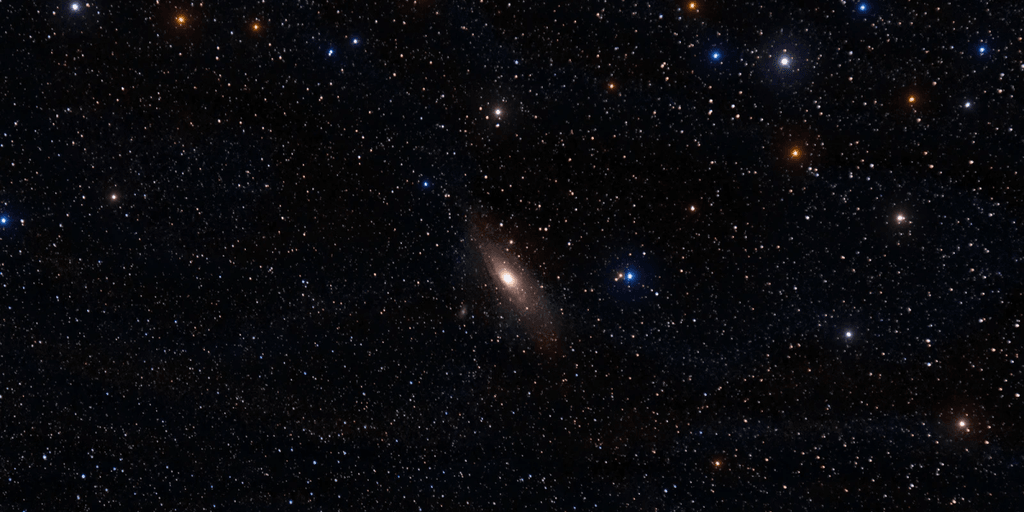
NASA’s Webb telescope traced a record-distant fast radio burst to a young, star-forming dwarf galaxy, offering new cosmic clues.
A New Clue From Deep Space
Researchers announced the discovery on October 8 after using Webb to investigate the galaxy associated with a radio burst designated FRB 20240304B.
Fast radio bursts are brief flashes of radio waves that can be detected across enormous cosmic distances. Their duration is typically measured in milliseconds, yet their signals can be powerful enough to be observed by radio telescopes on Earth.
Scientists have proposed several explanations for their origins, but the physical processes responsible for all fast radio bursts remain uncertain. Identifying the galaxy associated with a burst gives researchers a way to investigate the conditions in which it occurred.
The newly studied event is especially important because its host galaxy was confirmed to have a cosmological redshift of 2.148. That places the burst in an era when the universe was approximately three billion years old.
How the Technology Works
The James Webb Space Telescope was designed to observe infrared light from distant astronomical objects. Its instruments allow scientists to examine galaxies whose light has been stretched toward longer wavelengths by the expansion of the universe.
For FRB 20240304B, researchers used Webb observations to identify spectral features associated with elements including oxygen and hydrogen. Those features helped establish the host galaxy's redshift and confirm the event's extraordinary distance.
The result demonstrates how different astronomical instruments can work together. Radio telescopes detect the brief burst, while follow-up observations identify and characterize the galaxy associated with the signal.
Webb's contribution is particularly valuable because faint galaxies at large distances can be difficult to study in detail. Its infrared capabilities help researchers investigate objects from an earlier period of cosmic history.
Why Fast Radio Bursts Remain Mysterious
The origin of fast radio bursts is one of the questions astronomers are still working to resolve. Some observed bursts repeat, while others have not been detected again. Their diversity suggests that researchers must examine multiple events before drawing broad conclusions about their causes.
One possibility involves highly energetic processes associated with compact stellar remnants, but scientists continue to investigate the range of mechanisms that could produce the observed signals.
A host galaxy provides environmental context. Its size, star-formation activity and other properties can help researchers test whether particular types of galaxies are more commonly associated with specific bursts.
Webb's observations showed that the host of FRB 20240304B is a small dwarf galaxy actively forming stars. That finding supplies another example for comparison with other known hosts.
It does not establish that all fast radio bursts originate in dwarf galaxies or that star formation alone explains the phenomenon.
What Redshift Reveals
Redshift is a measure of how much light has shifted toward longer wavelengths. On cosmological scales, it helps astronomers estimate how far away an object is and how long ago its light was emitted.
The confirmed redshift of 2.148 indicates that the light studied from the host galaxy began its journey when the universe was much younger than it is today.
Observations of distant galaxies allow scientists to investigate how galaxies formed and evolved over time. Linking a fast radio burst to a specific galaxy adds another dimension to that research by connecting a transient event with its surrounding environment.
The result also illustrates why astronomical discoveries often require several stages. Initial detection identifies a signal, follow-up observations establish its location and additional measurements help determine the properties of its source.
Technology and Scientific Collaboration
The discovery involved radio observations by the MeerTRAP team using the MeerKAT telescope and follow-up work with Webb. Researchers from multiple institutions contributed to identifying the host and interpreting the measurements.
This type of collaboration is increasingly important in astronomy, where transient signals may be brief and distant objects require different observing techniques to understand.
The process also highlights the role of specialized technology. Radio instruments detect the burst, infrared instruments analyze the galaxy, and scientific models help interpret the measurements within the wider history of the universe.
What Comes Next
Further observations will be needed to determine how FRB 20240304B compares with other events and whether its host galaxy shares characteristics with other distant sources.
Researchers can examine additional host galaxies, investigate repeated bursts and compare observations across different wavelengths. Such work may help narrow the range of possible explanations for fast radio bursts.
For technology-minded readers, the discovery demonstrates how advanced instruments can turn a fleeting signal into a more detailed scientific investigation.
Webb did not solve the mystery of fast radio bursts, but it supplied an important piece of evidence. Its ability to characterize a distant host galaxy expands the information available to researchers studying some of the universe's most enigmatic radio signals.

Men’s Insider Contributor
Nicole Warren
Covers entrepreneurship, career growth, and business trends with accessible insights for a broad audience.
This article features partner, contributor, or branded content from a third party. Members of the Men’s Insider editorial staff were not involved in the creation of this content. All views and opinions are those of the contributor alone.