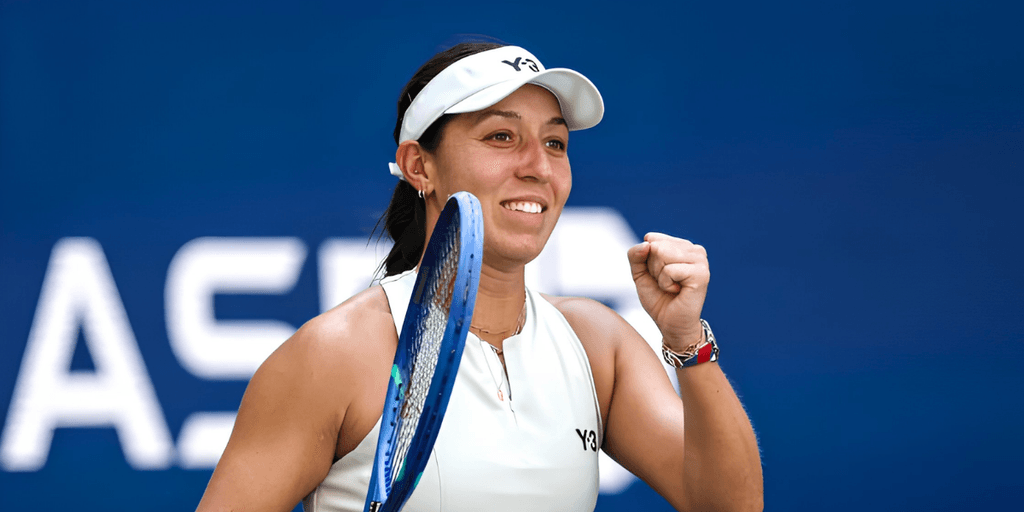
The U.S. Open began Sunday in New York with American third seed Jessica Pegula advancing to the second round and several established players facing immediate setbacks because of injuries or early defeats.
Pegula defeated Romania's Elena-Gabriela Ruse 6-3, 6-2 at Arthur Ashe Stadium, providing one of the strongest opening-day performances by an American player.
The victory was significant because Pegula entered the tournament as the third seed and one of the leading American contenders.
Her position in the draw carries expectations, particularly at the U.S. Open, where home players traditionally receive substantial attention from New York crowds.
Pegula's opening performance was controlled rather than dramatic.
She won in straight sets and avoided the extended physical demands that can complicate the opening rounds of a Grand Slam tournament.
The result allowed her to move into the second round while conserving energy for the longer tournament ahead.
The opening day also demonstrated how quickly a Grand Slam field can change.
Former U.S. Open champion Marin Cilic withdrew because of injury before playing his first-round match. Casper Ruud, who reached the U.S. Open final in 2022, also withdrew with a back injury.
Their withdrawals created opportunities for lucky losers Otto Virtanen and Arthur Gea.
The changes illustrate one of the most difficult aspects of professional tennis: players must remain physically prepared through a long season in which injuries can dramatically alter tournament draws.
Another seeded player, Barbora Krejcikova, was eliminated Sunday.
The 27th seed lost to Uzbekistan's Kamilla Rakhimova 7-6(4), 6-2 and became the first seeded player to exit the women's singles tournament.
Krejcikova's defeat was particularly notable because she is a two-time Grand Slam champion.
She saved six match points but could not prevent Rakhimova from completing the upset.
Jasmine Paolini, seeded 19th, avoided a similar outcome.
The Italian defeated Slovenia's Veronika Erjavec 6-3, 3-6, 6-4 after losing the second set. Her recovery demonstrated the additional pressure placed on seeded players when an opponent begins to gain momentum.
On the men's side, Kamil Majchrzak became the first men's player to advance Sunday after defeating Serbia's Hamad Medjedovic in straight sets.
The opening day also featured several of the sport's biggest names, including Novak Djokovic and Daniil Medvedev.
Their presence underscored the depth of the field and the international attention surrounding the tournament.
For American sports fans, however, Pegula's victory was one of the clearest early highlights.
The United States has been searching for sustained success in men's and women's singles, and Pegula has become one of the country's most consistent top-ranked players.
A deep run in New York would strengthen that position, although one opening-round victory is only the beginning of the tournament.
The U.S. Open also carries a distinctive physical challenge.
New York's hard courts, large crowds and intense schedule can place substantial demands on players, particularly as the tournament progresses.
Players must balance immediate match performance with recovery and preparation for later rounds.
The early withdrawals by Cilic and Ruud demonstrate the importance of that physical equation.
The tournament's first day therefore offered a mixture of American success, seeded-player vulnerability and injury-related uncertainty.
Those elements are likely to shape the competition as the draw advances.
For men who follow professional sports, the U.S. Open provides one of the year's clearest examples of individual competition under sustained physical pressure.
Players have to win repeatedly, manage fatigue and recover quickly while facing opponents who can change a tournament with a single upset.
Pegula's opening victory gave American fans an encouraging start.
But with two weeks of competition still ahead, the defining matches of the 2026 U.S. Open remain to be played.

Men’s Insider Contributor
Marcus Hale
Covers sport and breaking news, following the competition and the people at the centre of the story.
This article features partner, contributor, or branded content from a third party. Members of the Men’s Insider editorial staff were not involved in the creation of this content. All views and opinions are those of the contributor alone.