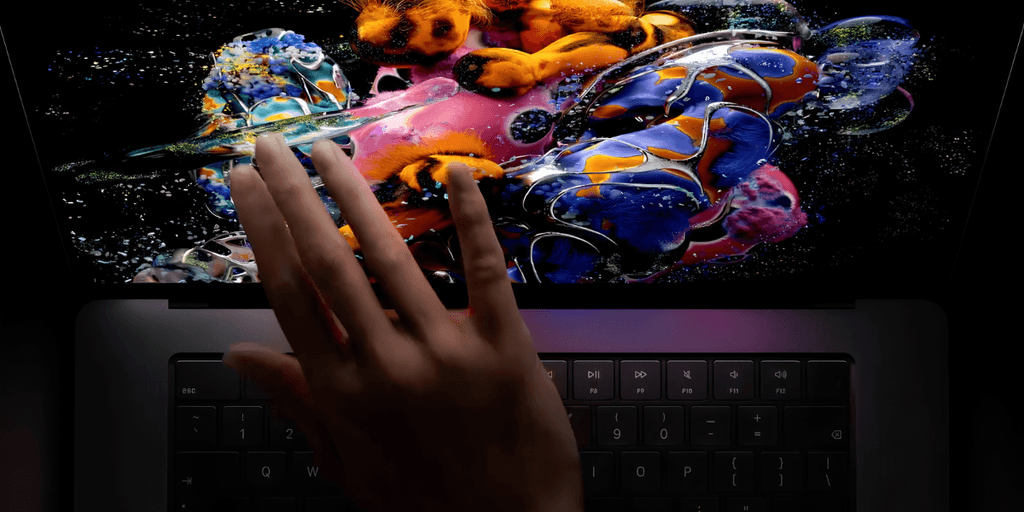
Apple's new MacBook Pro introduces touchscreen interaction, an OLED display, and upgraded processors for professionals.
Apple introduced a new generation of MacBook Pro laptops on October 28, adding touchscreen controls to a product line that has traditionally relied on a keyboard and trackpad. The announcement combines a change in user interaction with updated display technology and new processing hardware, positioning the laptops for professionals who need powerful mobile computers for creative and technical work.
The new models come in 14-inch and 16-inch sizes and use Apple's M5 Pro and M5 Max chips. They also feature a tandem OLED display marketed as PROLED XDR, with the company emphasizing brightness, contrast, color reproduction and responsiveness.
Preorders opened on October 28, with availability scheduled to begin November 6. The 14-inch MacBook Pro with M5 Pro starts at $2,899 in the United States, while the 16-inch version starts at $3,399.
A new way to interact with macOS
Touch input has been common on many laptops for years, but Apple's decision to introduce it to the MacBook Pro is a notable change for its professional computing range. The company says users can scroll, zoom, move objects and interact directly with onscreen content.
For creative professionals, direct manipulation may prove useful when working with images, presentations, visual designs and some software instruments. Rather than relying entirely on a trackpad, users can touch the element they want to move or adjust.
Apple is retaining the keyboard and trackpad, allowing users to combine touch interaction with established shortcuts and gestures. This matters because professional workflows often depend on precision and speed. Touch may be convenient for some tasks, while keyboard commands or trackpad gestures remain more effective for others.
The new design also raises questions about software support. Hardware alone does not guarantee a better workflow: applications must make meaningful use of touch controls, and users will need to determine whether the feature improves their particular work.
Display quality for demanding workloads
The new display uses tandem OLED technology, which Apple says delivers peak HDR brightness of up to 2,000 nits and a 120Hz variable refresh rate. The company also highlighted support for a wider color range, including P3 and Adobe RGB.
Display performance can be particularly important for photographers, video editors and designers. These users need to evaluate fine details, contrast and color while working with material intended for different screens, print processes or professional delivery standards.
OLED technology can produce deep blacks because individual pixels can be controlled independently. Tandem designs use multiple organic light-emitting layers to improve performance, although real-world results depend on implementation, calibration and operating conditions.
For professionals, a laptop display may reduce the need to carry an external monitor during travel. However, users whose work requires highly controlled color accuracy may still need calibrated equipment and suitable viewing environments.
Processing power and storage
The M5 Pro and M5 Max chips are designed for demanding workloads, while configurations offering up to 128GB of unified memory and 16TB of storage target users who handle large projects or multiple intensive applications.
Memory capacity can affect performance when working with high-resolution video, complex software development environments, large image libraries or data-heavy applications. Storage capacity is also important for users who maintain large project files locally rather than relying entirely on external drives or cloud services.
Apple's announcement included Thunderbolt 5 connectivity, a 12-megapixel Center Stage camera, studio-quality microphones and a six-speaker sound system. The company also advertised battery life of up to 24 hours, although battery performance varies according to workload, configuration and settings.
What the launch means for buyers
The new MacBook Pro enters a premium laptop market where manufacturers compete on performance, portability, battery life, displays and artificial intelligence features. Apple's touchscreen addition gives customers another option, but the high starting prices mean the upgrade will not make financial sense for every user.
People considering a new machine should compare the specifications with their actual workloads. A professional who frequently edits large video files may value processing power and memory more than touch interaction. A designer may place greater importance on the display, while a developer may focus on software compatibility and sustained performance.
The launch also illustrates how laptop design continues to evolve as the boundaries between traditional computers and touch-first devices become less rigid. Whether the new controls become a central part of professional Mac workflows will depend on how users and developers adopt them.
With preorders open and availability approaching, Apple's latest MacBook Pro offers a substantial change in the way users can interact with the company's premium laptop range.

Men’s Insider Contributor
Nicole Warren
Covers entrepreneurship, career growth, and business trends with accessible insights for a broad audience.
This article features partner, contributor, or branded content from a third party. Members of the Men’s Insider editorial staff were not involved in the creation of this content. All views and opinions are those of the contributor alone.