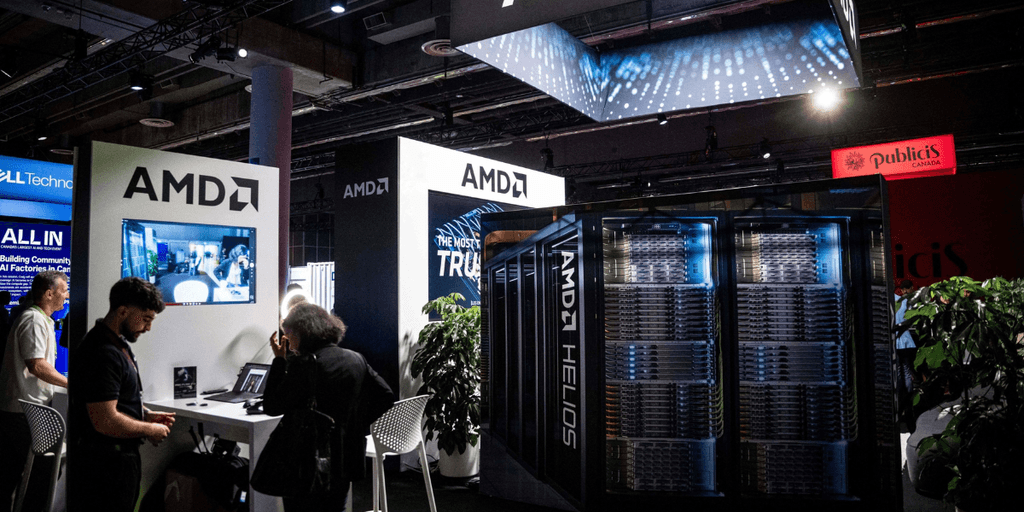
AMD crossed a $1 trillion market value as demand for AI computing hardware drove a broad semiconductor rally.
AMD Reaches a New Valuation Milestone
Advanced Micro Devices crossed a $1 trillion market capitalization for the first time as investors pushed semiconductor stocks higher amid continuing demand for artificial intelligence computing.
The rise placed AMD among the small group of chip companies valued above the trillion-dollar threshold and helped push the Nasdaq to a record closing level.
The development is significant for the technology industry because AMD is one of the companies competing to supply processors for the rapidly expanding AI infrastructure market.
AI applications increasingly require specialized computing hardware, particularly when companies operate large models or process substantial quantities of data.
Why AI Needs So Much Computing Power
Modern AI systems depend on powerful processors to train models and generate responses.
Training can require enormous amounts of computing capacity, while businesses running AI applications need additional infrastructure for everyday use.
That demand has created a major market for chips designed to handle parallel computing and other workloads associated with machine learning.
AMD has expanded its data-center business while competing with Nvidia and other semiconductor companies.
The competition has become one of the defining technology stories of the current AI expansion.
Semiconductor Stocks Rally
AMD's rise occurred as semiconductor companies broadly gained.
The Philadelphia semiconductor index climbed 4.3%, while the Nasdaq reached a record close. The S&P 500 increased 1.49% and the Dow rose 0.71%.
The gains demonstrate the degree to which investors continue to associate AI with growth in the technology sector.
Other semiconductor companies, including Intel and Arm, also benefited from the rally.
The market movement reflects expectations that demand for AI infrastructure will continue increasing as businesses adopt more advanced systems.
Competition Is About More Than Chips
The AI hardware market is not determined solely by processor performance.
Software compatibility, energy efficiency, memory capacity and the broader development ecosystem are also important.
Companies purchasing AI infrastructure need systems that can operate efficiently at scale.
For developers, compatibility with software tools can influence which hardware platform is practical.
That has made competition between chip companies increasingly complex.
AMD's market gains therefore reflect both its own business development and the wider expansion of the AI computing market.
AI Is Changing Consumer Technology Too
Although large data centers receive much of the attention, AI is also becoming more common in consumer technology.
Smartphones, computers, cameras, gaming systems and other devices increasingly include AI-related functions.
Those applications create demand for processors capable of performing AI tasks locally.
Local processing can reduce reliance on remote servers for some functions and can improve response times for certain applications.
The trend is encouraging chip companies to develop processors that can handle AI workloads across both data-center and consumer environments.
What the Milestone Says About the Industry
AMD's $1 trillion valuation demonstrates how much investor attention has shifted toward AI infrastructure.
The company has existed for decades, but the current AI expansion has created a new opportunity for semiconductor manufacturers capable of supplying high-performance computing systems.
The broader industry is responding with significant investment in chip design, manufacturing capacity and supporting software.
Technology companies are also developing increasingly specialized processors as AI workloads become more diverse.
A Competitive Market Ahead
The current AI boom has created strong demand for computing hardware, but the semiconductor market remains competitive.
Companies must continue investing in research and development while maintaining supply chains and delivering products that meet rapidly changing customer requirements.
The market is also sensitive to changes in corporate spending.
If major technology companies slow investment in AI infrastructure, semiconductor demand could change. Conversely, continued expansion of AI services could sustain demand for advanced processors.
AMD's latest milestone therefore represents both a measure of current market confidence and a reflection of the strategic importance of AI computing.
For technology-focused consumers and professionals, the development highlights how the devices and services they use increasingly depend on a semiconductor industry being reshaped by artificial intelligence.

Men’s Insider Contributor
Nicole Warren
Covers entrepreneurship, career growth, and business trends with accessible insights for a broad audience.
This article features partner, contributor, or branded content from a third party. Members of the Men’s Insider editorial staff were not involved in the creation of this content. All views and opinions are those of the contributor alone.